Robert Weiss III looked down at his sneakers and took a short breath.
To his right, his team stretched and discussed strategy before turning to their coach a few minutes before the biggest game of the season. As a former volleyball and wrestling coach, Weiss III’s searched his mental Rolodex for the right motivational speech — and then it clicked.
“You’re more prepared than they are,“ Weiss III said, with a steady voice. “You’re ready for this!”
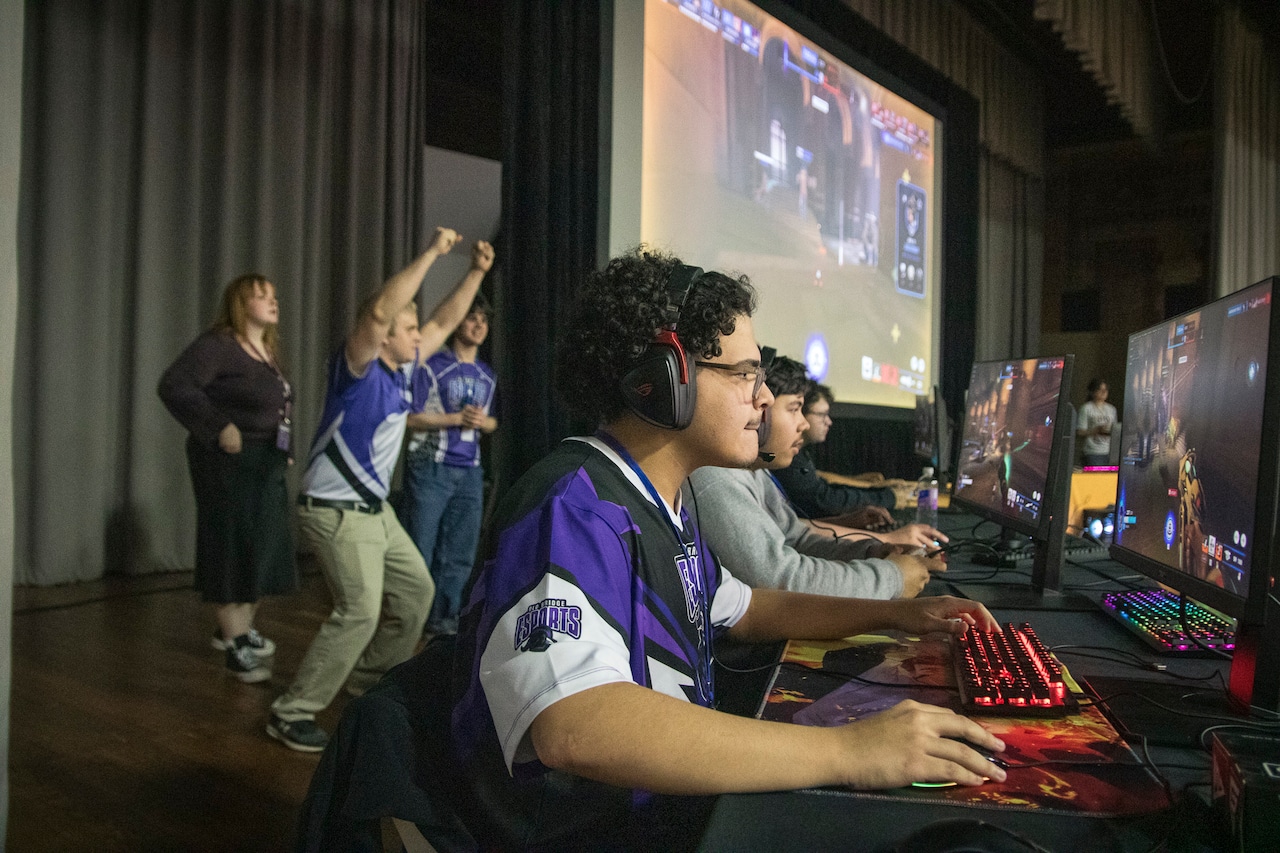
The Garden State Esports Winter Championships weren’t your typical sporting event. Weiss III coaches the esports team at Old Bridge High School in Middlesex County, and his players were preparing for a “Battle of Route 18” showdown against rival East Brunswick High in Overwatch — a popular multiplayer first-person shooter video game.
Animated Old Bridge esports players filled the front of the casino at Georgian Court University alongside fans and family members. But in a back-and-forth matchup that lasted over an hour, East Brunswick gained the upper hand and held on to beat Old Bridge, becoming the Group IV Winter Overwatch state champions.
“Be proud of yourselves,” Weiss III told his players afterward, exhausted. “We’ll be back.”
The passion on display during the eight-hour championships, which saw 25 of the top high schools and middle schools from across New Jersey compete in front of more than 2,000 fans, is central to the mission of Garden State Esports — the largest scholastic esports league in the country.
Since 2020, GSE has grown into a non-profit powerhouse, with over 12,000 kids from more than 400 New Jersey schools competing. The league has become a hotbed of talent, creating a pipeline scouted by more than 100 colleges, including Rutgers, Syracuse and Rowan, which offer scholarships to the top players.
“Esports is the only place that some Jersey schools are going to be able to be national champions,” said Chris Aviles, the GSE founder.
Aviles, a former English teacher and coach in Fair Haven, had tried to start an esports team at his school since 2011. The lack of infrastructure and technology — combined with the school district’s reluctance — impeded progress for years. But after much planning and advocating, Aviles finally received the school district’s approval in 2018 and started the first middle school esports team in the country, the Fair Haven Knights.
During the COVID-19 pandemic, when students were stuck in remote learning and disconnected from in-person connections, Aviles saw an opportunity to grow his vision. He sent laptops to his students and pitched teachers into starting a Rocket League tournament — think virtual soccer with an oversized ball and vehicles instead of athletes like Lionel Messi.
Since 2020, more than 200 U.S. colleges and more than 8,600 high schools have started varsity esports programs, according to the National Association for Collegiate Esports. Meanwhile, New Jersey has been growing its own esports ecosystem, from middle schools up to the college ranks. The state launched Conference One (CF1), a collegiate sports league, in 2020. Eleven colleges and 18 community colleges in the state have esports teams and offer scholarships. New Jersey also ranks eighth in the country for esports prize earnings for athletes, at $3.5 million, according to Action Network.
While CF1’s activity waned, GSE took the mantle and launched its own collegiate conference in the spring of 2023. The GSE Collegiate Conference serves as the state’s lone college league, the only in-person college league in the country, and an in-state recruiting pipeline. 22 of the 36 colleges in New Jersey, such as Seton Hall, Brookdale and Princeton, are conference members.
“When you substitute the soccer field for a virtual field, people have a hard time imagining the benefits,” Aviles said. “We get two dozen kids’ scholarships every year. Esports has millions of dollars in scholarships and New Jersey kids need to be in that mix.”
Mirroring traditional athletics
GSE groups the 412 competing high schools in the spirit of traditional school classifications established by the New Jersey State Interscholastic Athletic Association, the state’s governing body for high school sports. The league is then broken down by regional conferences and specific video games, using custom matchup software. About 50% of teams in each conference qualify for the playoffs. Those 24 to 28 teams then move on to winter or spring championship matches.
The director of competition, Mike Johnson, who handles scheduling, wanted to ensure an in-person element to esports, so that competitors not only fuel rivalries as in traditional sports, but also form friendships.
“We see incredible sportsmanship after the matches,” Johnson said. “There might be a scenario where we get swept out of the playoffs, but the other team comes over and says, ‘Hey, man, you made some really good plays in that second game.’ It picks everybody up.”
Since 2016, the national college esports ecosystem has grown to over 300 institutions with 16,000 student-athletes, according to the National Association of Collegiate Esports. This February, GSE held the first-ever esports college combine in the country, where the 29 attending colleges and universities combined for 181 recruitment offers, including $99,000 in production and ecaster scholarships and full scholarships for two GSE athletes.
“Garden State has, if not already, led the country in terms of their development scholastically in the state,” said Travis Yang, Syracuse’s Director of Esports competition. “For us, New Jersey is one of the top priority recruiting grounds.”
Yang stated that an average scholarship offer for a top-five-level recruit from Syracuse could range from $20,000 to $30,000. Yang also stressed that aspiring esports athletes should focus on “one or two games” like Overwatch or Rocket League, and that intangibles such as leadership and communication can set them apart.
One student Yang has been scouting is Nick Sellers, a senior from Barnegat High School and one of the top Overwatch players in the country. His mother, Traci Sellers, is a teacher and head coach of the school’s Overwatch team.
As a gaming family, Nick played a wide range of video games growing up. Traci Sellers insisted that he focus on one or two games, with Overwatch becoming his primary choice at 11. His skills reached new heights at Barnegat.
“Going into high school, I was worried about who I would hang out with,” Nick Sellers said. “Ever since esports, I’ve been making friends left and right, meeting people I never thought I would ever meet. I probably wouldn’t be the same person without it.”
Nick Sellers has been in an ideal setting under the direction of his mom, who helped create an Overwatch dynasty that has won three state championships.
“You want your kid to be involved in something so that they want to go to school,” Traci Sellers said. “If that’s video games, embrace it! With esports, my kids are so comfortable because they’ve made friends and found people who love the same thing that they do in a structured environment.”
GSE events are completely student-led, from production and lighting to sportscaster roles. It’s the result of the non-profit organization’s workforce development program. About 50% of athletes go on to study STEM majors, according to the United States Academic Esports League.
“The CODEX curriculum exposes students to 16 career pathway jobs that give them real-world skills they can use to pursue a career,” said Jim McKowen, the GSE vice president. “You’re giving students real-life experience that they can use to build a portfolio to show prospective colleges or even career opportunities.”
Tackling gaming misconceptions
Negative perceptions about video gaming have plagued the medium for decades. Critics and concerned parents believe online gaming can be isolating and could contribute to rising public health concerns over loneliness in young people. Higher rates of anxiety and depression have been directly correlated with 50.4% of U.S. teens ages 12–17 spending four or more hours daily on screens, the CDC notes.
GSE officials said it’s addressing those concerns through data analysis and establishing inclusive institutional pillars.
One initiative is the Valkyrie League, an all-girls competition comprising 450 student-athletes. The division helps girls overcome unique barriers female gamers face, and also serves as an on-ramp for students to join the co-ed varsity teams.
There’s also the Unified League, which includes students with academic, physical, or cognitive challenges and is the fastest-growing part of the GSE competition. The division includes about 600 kids across New Jersey.
Aaron Feinstein, a Freehold High senior, is one of the top 500 Overwatch players in the country. About six colleges have expressed interest in offering him scholarship money; his parents credit the Freehold esports team for giving their son a place to feel included.
“Before esports, Aaron was not involved in any extracurricular activities at school,” said his mother, Karen Newman. “His level of confidence has skyrocketed, and I just don’t remember him having that same level before he participated in these programs and played esports. I couldn’t be prouder.”
Also on Aaron Feinstein’s team is Erol Bayrasli, a Freehold senior who was the starting center for the football team. He normally did little during the winter months before baseball season. But his interest in Overwatch led him to join the esports team with his friends.
Bayrasli’s teammates describe him as the “hypeman they were missing,” and along with Aaron Feinstein, they became Group IV Overwatch champions — a byproduct of GSE forging connections with kids from different backgrounds.
“As a center, you’re talking and looking at everybody on the field,” the Freehold senior said. “For esports and Overwatch in general, that same type of coordination and preparation is a big key to winning.”
Another major concern with gaming is potential inactivity.
About 28% of 6- to 17-year-olds nationally meet the recommended 60 minutes of daily physical activity, according to the most recent study by the Physical Activity Alliance. That’s why the GSE has made it a point to address the physical well-being of its athletes.
Weiss III carries an athlete’s mindset, treating physical preparation as a pillar of his Old Bridge team. Before every Overwatch match at the winter championship, the coach led his team through full-body stretches. Once the team gets to their computers, they do both neck and desk stretches as another warm-up.
“My kids require physicals,” Weiss III said. ”When they get to practice after school, they’ve been sitting all day. Once they get to the practice room, they log in, and then I say, ‘Go for a walk.” What I really like about the walks is that players coordinate, plan, and strategize. It’s something so small, but you don’t realize how big a difference it makes.”
Budget constraints limit the bigger picture
Although GSE has a healthy mix of funding from grants and corporate partnerships, electronics remain a hefty cost for some school districts already facing budget crunches. A Nintendo Switch 2 is considered on the lower end of pricing and still costs around $450.
GSE Vice President Regina Schaffer Carr is working to launch an urban league that would partner with Historically Black Colleges and Universities to bring esports to underserved communities.
“A lot of urban districts don’t have the money for a $3,000 gaming computer,” Carr said. “I’m also hoping to be able to pull a fund where districts can apply, and we can get people to sponsor schools or to build an esports lab.”
Christian Palomba coaches the East Side High esports team in Newark, one of the city’s three teams. East Side works with a revolving roster of players for the winter and spring seasons.
“The day I told the kids [about the team], I had a line of kids outside my room,” Palomba said. “So I literally just went out that afternoon and bought a Nintendo Switch and some games, and we started playing right then to keep the kids interested.”
Palomba said the district has been financially supportive, buying computers, controllers, and new furniture. Still, challenges remain from sheer day-to-day usage.
“We need to buy some new games, and now the controllers are getting old,” Palomba said. “A lot of that equipment isn’t built to last. That’s a challenge.”
None of the teachers involved with GSE earn a salary or stipend, but Aviles worries about burnout from volunteers. The founder believes GSE should be considered for state appropriations, given its positive impact on students and workforce development. He cites a setup in Washington State, where a similar esports program received $250,000 in appropriations in 2022.
GSE claims some schools are reluctant to partner with the company or give varsity letters because it does not operate under the NJSIAA umbrella. The organization has sought a formal endorsement from the NJSIAA. GSE says its offers have been rebuffed.
GSE officials said that an acknowledgment from the NJSIAA would make it easier to secure state appropriations and further solidify its strides in education and workforce development.
“At this time, the NJSIAA is not actively monitoring the e-sports space and does not anticipate taking up the issue for consideration,” according to a NJSIAA spokesman.
While athletes have a desire to turn pro, the esports competitive landscape is even harder to break into than traditional sports. The percentage of esports players who “go pro” is less than 1%, according to Healthy Gamer. There are only 3,530 active esports professionals in the U.S., according to DemandSage. Aviles states that a number of Garden State Esports athletes have reached the “AAA baseball” level, but not yet the professional ranks. The GSE founder cites an underdeveloped ecosystem, a lack of consistent support from game publishers, and the limited number of available roster spots (only 5-7 per professional team) as persistent problems.
Through it all, GSE says its impact is undeniable in a medium that’s often been misconstrued and dismissed as a brain-rotting hobby. A 2025 study by Monmouth University found that students in three New Jersey schools who participated in the GSE program missed fewer days of school and helped districts recover $20,106 in attendance-based funding. And over half of the students who participated on a GSE team had never been involved in an extracurricular activity.
“These kids are not only succeeding, but they’re thriving,” McKowen said. “They’re finding their voice and finding people with whom they’re comfortable being themselves. It’s a beautiful thing to watch.”
N.J. teens are nabbing $30K scholarships playing video games. Inside the biggest junior esports league in U.S.